





Open security scanner for AI supply chain — agents, MCP servers, packages, containers, cloud, GPU, and runtime.
Every CVE in your AI stack is a credential leak waiting to happen. agent-bom follows the chain end-to-end and tells you exactly which fix collapses it.

CVE-2025-1234  (CRITICAL · CVSS 9.8 · CISA KEV)
  |── better-sqlite3@9.0.0  (npm)
       |── sqlite-mcp  (MCP Server · unverified · root)
            |── Cursor IDE  (Agent · 4 servers · 12 tools)
            |── ANTHROPIC_KEY, DB_URL, AWS_SECRET  (Credentials exposed)
            |── query_db, read_file, write_file, run_shell  (Tools at risk)

 Fix: upgrade better-sqlite3 → 11.7.0
Blast radius is the core idea: CVE -> package -> MCP server -> agent -> credentials -> tools. CWE-aware impact keeps a DoS from being reported like credential compromise.
agent-bom agents --demo --offlineThe demo uses a curated sample so the output stays reproducible across releases. Every CVE shown is a real OSV/GHSA match against a genuinely vulnerable package version — no fabricated findings (locked in by tests/test_demo_inventory_accuracy.py). For a real scan, run agent-bom agents, or add -p . to fold project manifests and lockfiles into the same result.

| Goal | Run | What you get |
|---|---|---|
| Find what is installed and reachable | agent-bom agents -p . |
Agent discovery, MCP mapping, project dependency findings, blast radius |
| Turn findings into a fix plan | agent-bom agents -p . --remediate remediation.md |
Prioritized remediation with fix versions and reachable impact |
| Check a package before install | agent-bom check flask@2.2.0 --ecosystem pypi |
Machine-readable pre-install verdict |
| Scan a container image | agent-bom image nginx:latest |
OS and package CVEs with fixability |
| Audit IaC or cloud posture | agent-bom iac Dockerfile k8s/ infra/main.tf |
Misconfigurations, manifest hardening, optional live cluster posture |
| Review findings in a persistent graph | agent-bom serve |
API, dashboard, unified graph, current-state and diff views |
| Inspect live MCP traffic | agent-bom proxy "<server command>" |
Inline runtime inspection, detector chaining, response/argument review |
pip install agent-bom                  # CLI
# pipx install agent-bom               # isolated global install
# uvx agent-bom --help                 # ephemeral run

agent-bom agents                              # discover + scan local AI agents and MCP servers
agent-bom agents -p .                         # add project lockfiles + manifests
agent-bom check flask@2.0.0 --ecosystem pypi  # pre-install CVE gate
agent-bom image nginx:latest                  # container image scan
agent-bom iac Dockerfile k8s/ infra/main.tf   # IaC scan, optionally `--k8s-live`
After the first scan:
agent-bom agents -p . --remediate remediation.md                  # fix-first plan
agent-bom agents -p . --compliance-export fedramp -o evidence.zip # auditor-ready bundle
pip install 'agent-bom[ui]' && agent-bom serve # API + dashboardThese come from the live product path, using the built-in demo data pushed through the API. See docs/CAPTURE.md for the canonical capture protocol.
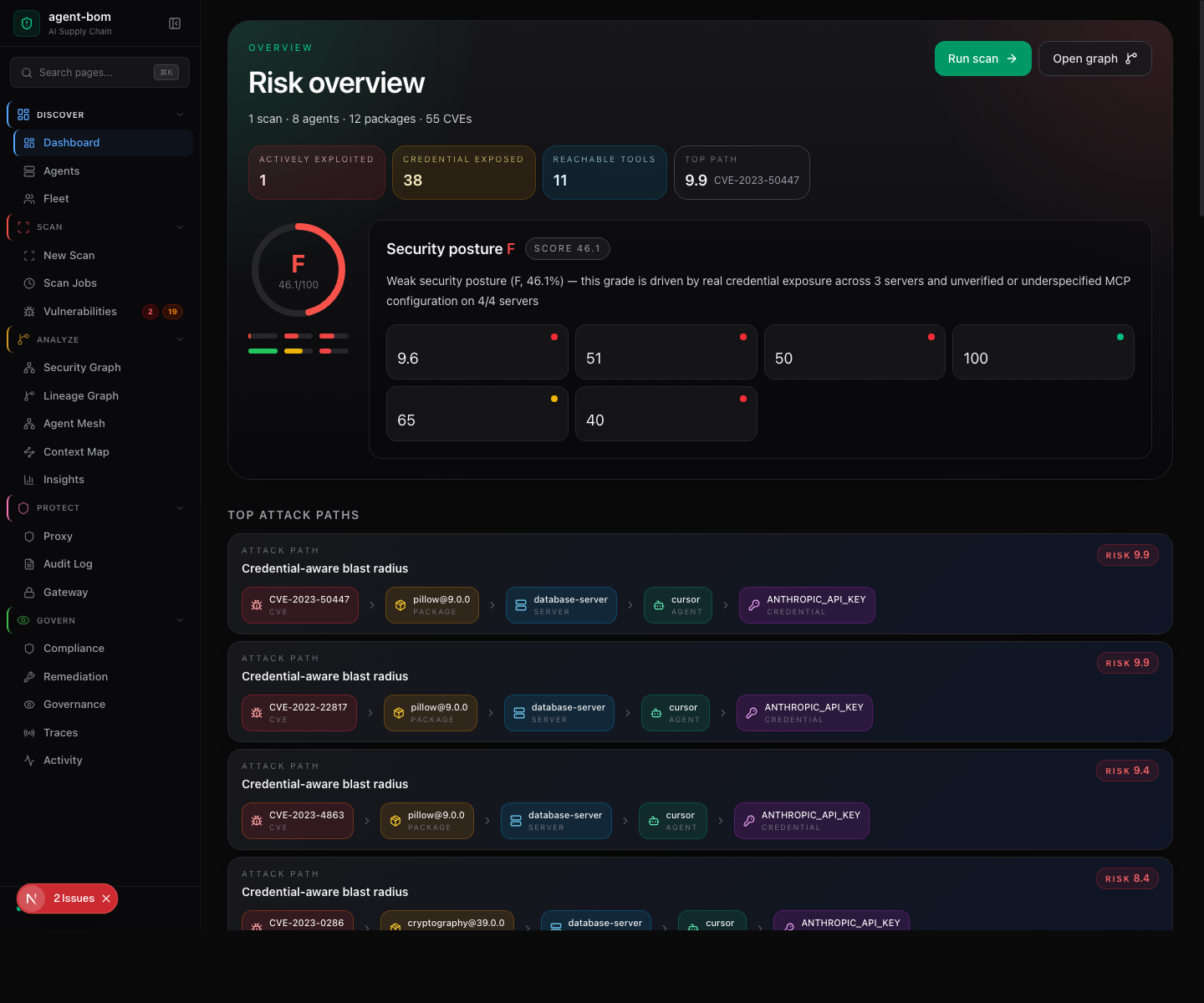
The landing page is the Risk overview: a letter-grade gauge, the four headline counters (actively exploited · credentials exposed · reachable tools · top attack-path risk), the security-posture grade with sub-scores (policy + controls, open evidence, packages + CVEs, reach + exposure, MCP configuration), the score breakdown for each driver, and the top attack paths with one-click drilldown.
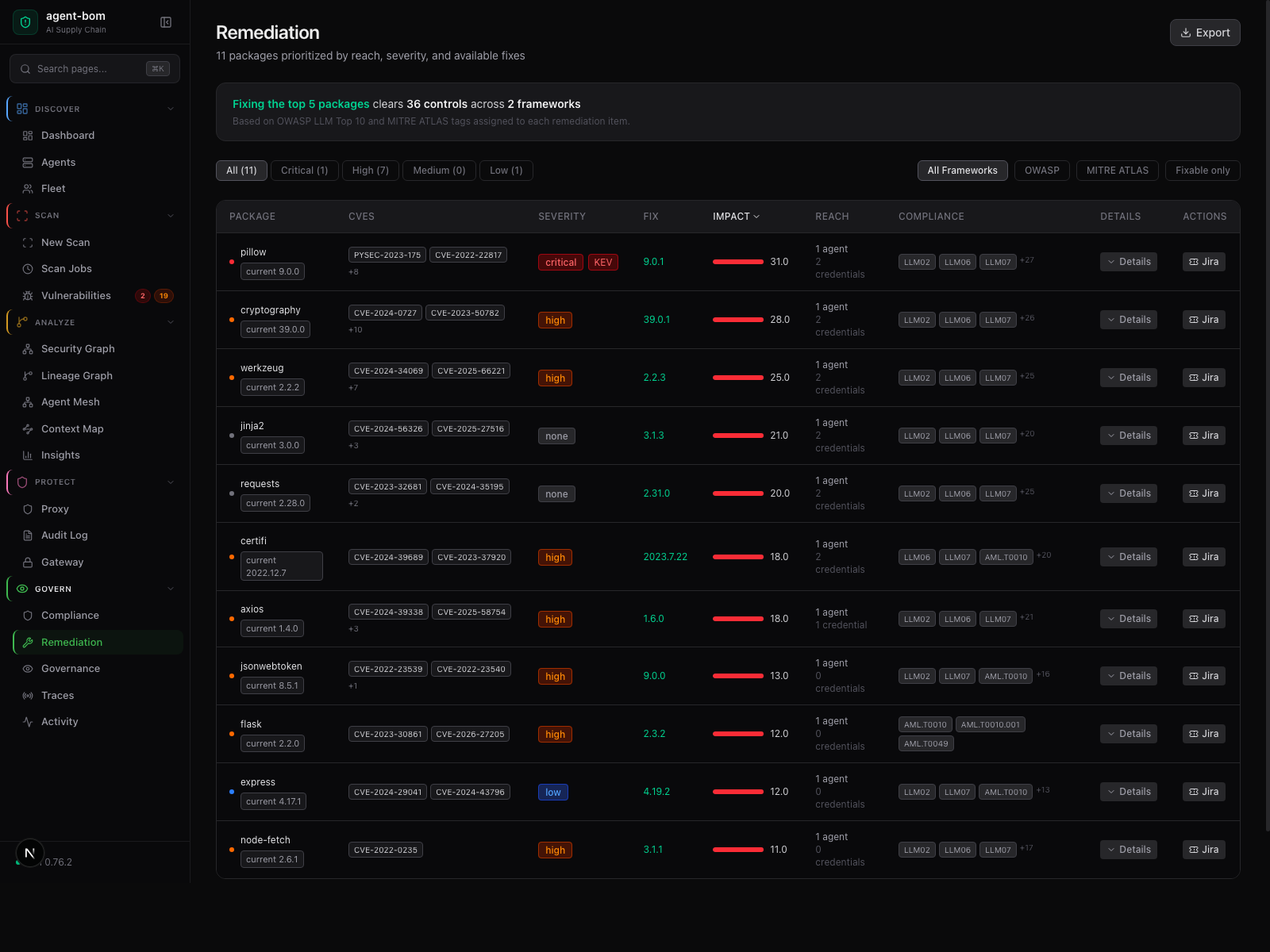
Risk, reach, fix version, and framework context in one review table — operators act without jumping between pages.
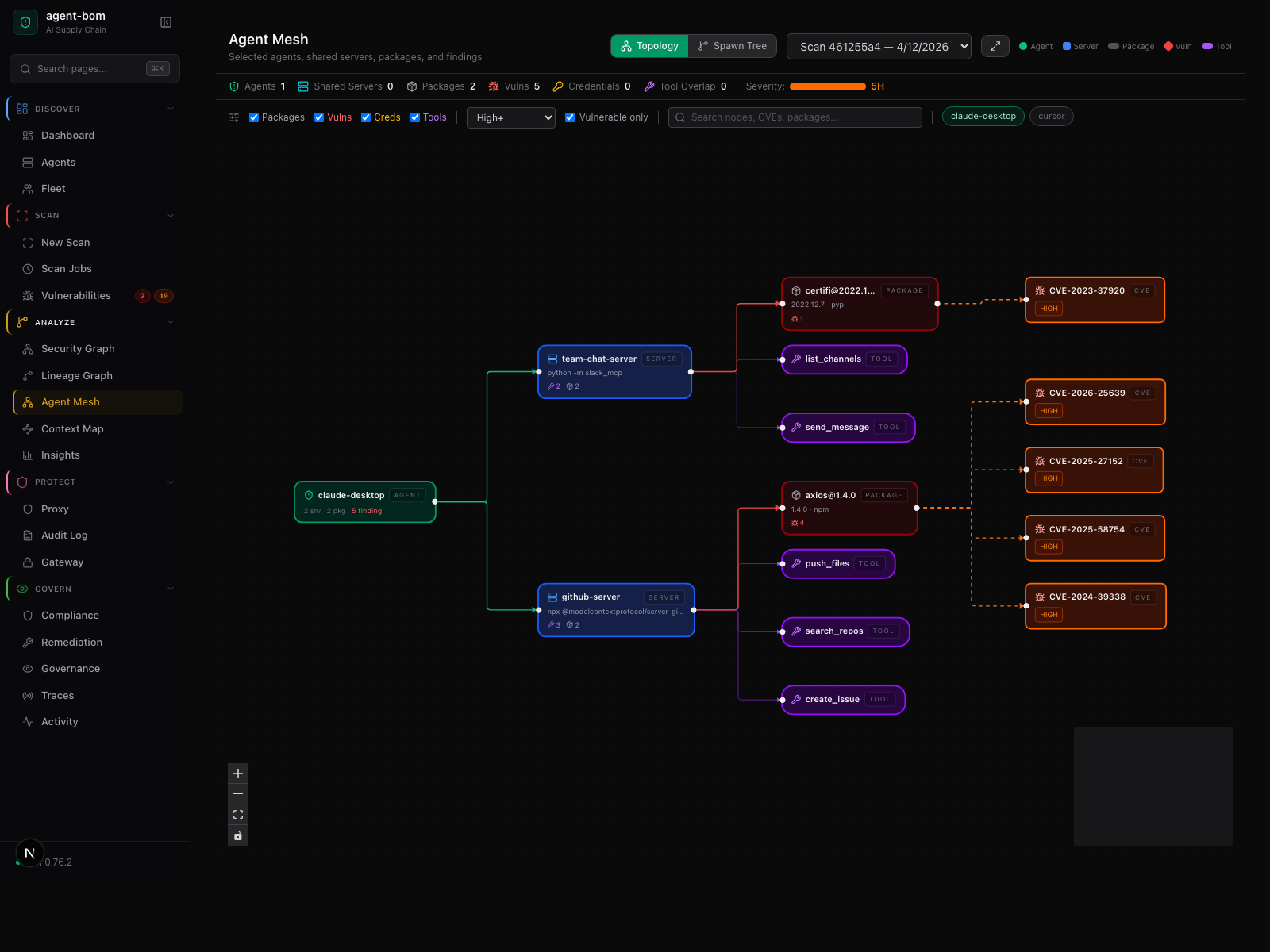
Agent-centered shared-infrastructure graph — selected agents, their shared MCP servers, tools, packages, and findings.
How a scan moves through the system — five stages, no source code or credentials leave your machine

Inside the engine: parsers, taint, call graph, blast-radius scoring.

External calls are limited to package metadata, version lookups, and CVE enrichment.
Self-hosted is a first-class path. agent-bom is designed to run inside the
customer's own AWS account, VPC, EKS cluster, IAM boundary, databases, and SSO
stack.
The deployable surfaces are intentionally split:
- scan: discovery, inventory, CVE, image, IaC, Kubernetes, and cloud analysis
- fleet: endpoint and collector inventory pushed into the control plane
- proxy / runtime: inline MCP enforcement near selected workloads
- gateway: central policy management for those runtime paths
- API + UI: findings, graph, remediation, audit, and operator workflows
That gives one shared graph and policy model without forcing one runtime monolith. By default, findings, fleet data, audit logs, graph state, and remediation outputs stay in your infrastructure; optional egress is operator controlled for DB refresh, enrichment, SIEM, OTLP, and webhooks.
flowchart LR
clients["Cursor · Claude · VS Code<br/>Codex · Cortex · Continue"]
cli["agent-bom agents --push"]
prx["agent-bom proxy <mcp>"]
cp(["agent-bom control plane<br/>in your EKS cluster"])
clients -.-> cli
clients -.-> prx
cli -->|HTTPS push| cp
prx -->|policy pull · audit push| cp
The Helm chart installs a single namespace with the control plane, its backup job, and the operator surface. Selected MCP workloads run alongside with an agent-bom-proxy sidecar that pulls gateway policy and pushes audit events back.
flowchart TB
    subgraph ns["namespace: agent-bom"]
        direction TB
        api["Deployment: agent-bom-api<br/>3 replicas · HPA · /readyz drain"]
        ui["Deployment: agent-bom-ui<br/>2 replicas"]
        cron["CronJob: controlplane-backup<br/>pg_dump → S3 (SSE-KMS)"]
        es[("ExternalSecret<br/>API keys · HMAC key · DB URL")]
        obs["PrometheusRule + Grafana dashboard ConfigMap"]
    end

    subgraph work["Selected MCP workloads (same or adjacent ns)"]
        direction LR
        mcpsvc["MCP server pod"]
        proxy["Sidecar: agent-bom-proxy"]
        mcpsvc -.- proxy
    end

    api --- ui
    api --- es
    api -. scrape / alert .- obs
    api --- cron
    proxy -->|policy pull · audit push| api
Outside the namespace but in your VPC: Postgres (primary state), ClickHouse (optional analytics), External Secrets wired to KMS, and Prometheus + Grafana + OTel scraping the API. The restore round-trip is exercised in CI (backup-restore.yml).
flowchart TB
    REQ([HTTP request])
    BODY[Body size + read timeout]
    TRACE[Trust headers + W3C trace]
    AUTH["Auth — API key · OIDC · SAML"]
    RBAC[RBAC role check]
    TENANT[Tenant context propagation]
    QUOTA[Tenant quota + rate limit]
    ROUTE[Route handler]
    AUDIT[(HMAC audit log)]
    STORE[(Postgres · ClickHouse<br/>KMS at rest)]

    REQ --> BODY --> TRACE --> AUTH --> RBAC --> TENANT --> QUOTA --> ROUTE
    ROUTE --> AUDIT
    ROUTE --> STORE
Every layer is testable on its own; failures emit Prometheus metrics. Operators introspect a live request via GET /v1/auth/debug and see rotation status via GET /v1/auth/policy.
Inside the control plane: OIDC + SAML SSO with RBAC, enforced API-key rotation policy, tenant-scoped quotas + rate limits, HMAC-chained audit log with signed export, KMS-encrypted Postgres backups with a verified restore round-trip in CI, and signed compliance evidence bundles (/v1/compliance/{framework}/report — nonce + expiry inside the signature).
Helm install + fleet sync + local proxy
# control plane in your cluster
helm install agent-bom deploy/helm/agent-bom \
  --set controlPlane.enabled=true \
  --set db.backend=postgres

# endpoint fleet sync
agent-bom agents --preset enterprise --introspect \
  --push-url https://agent-bom.example.com/v1/fleet/sync

# local MCP enforcement on a laptop or workstation
agent-bom proxy --policy ./policy.json -- <editor-mcp-command>
Operator guides: Own AWS / EKS · Enterprise pilot · Endpoint fleet · EKS MCP pilot · Helm control plane · Grafana · Performance + sizing · Restore script.
Self-hosted SSO uses OIDC or SAML; SAML admins fetch SP metadata at /v1/auth/saml/metadata. Control-plane API keys follow an enforced lifetime policy (AGENT_BOM_API_KEY_DEFAULT_TTL_SECONDS, AGENT_BOM_API_KEY_MAX_TTL_SECONDS); rotate in place at /v1/auth/keys/{key_id}/rotate.
agent-bom is a read-only scanner. It never writes configs, never executes MCP servers, never stores credential values. No telemetry. No analytics. Releases are Sigstore-signed with SLSA provenance and self-published SBOMs.
| When | What's sent | Where | Opt out |
|---|---|---|---|
| Default CVE lookups | Package names + versions | OSV API | --offline |
| Floating version resolution | Names + requested version | npm / PyPI / Go proxy | --offline |
--enrich |
CVE IDs | NVD, EPSS, CISA KEV | omit --enrich |
--deps-dev |
Package names + versions | deps.dev | omit --deps-dev |
verify |
Package + version | PyPI / npm integrity endpoints | don't run verify |
| Optional integrations | Finding summaries | Slack / Jira / Vanta / Drata | don't pass those flags |
Full trust model: SECURITY_ARCHITECTURE.md · PERMISSIONS.md · SUPPLY_CHAIN.md · RELEASE_VERIFICATION.md.
Bundled mappings for FedRAMP, CMMC, NIST AI RMF, ISO 27001, SOC 2, OWASP LLM Top-10, MITRE ATLAS, and EU AI Act. Export auditor-ready evidence packets in one command.

agent-bom agents -p . --compliance-export fedramp -o fedramp-evidence.zip
agent-bom agents -p . --compliance-export nist-ai-rmf -o evidence.zip
The audit log itself is HMAC-chained and exportable as a signed JSON/JSONL bundle at GET /v1/audit/export.
pip install agent-bom                        # CLI
docker run --rm agentbom/agent-bom agents # Docker| Mode | Best for |
|---|---|
CLI (agent-bom agents) |
local audit + project scan |
Endpoint fleet (--push-url …/v1/fleet/sync) |
employee laptops pushing into self-hosted fleet |
GitHub Action (uses: msaad00/agent-bom@v0.78.0) |
CI/CD + SARIF |
Docker (agentbom/agent-bom) |
isolated scans, containerized self-hosting |
Kubernetes / Helm (helm install agent-bom deploy/helm/agent-bom) |
self-hosted API + dashboard, scheduled discovery |
REST API (agent-bom api) |
platform integration, self-hosted control plane |
MCP server (agent-bom mcp server) |
Claude Desktop, Claude Code, Cursor, Codex, Windsurf, Cortex |
Runtime proxy (agent-bom proxy) |
MCP traffic enforcement |
Shield SDK (from agent_bom.shield import Shield) |
in-process protection |
Backend choices stay explicit and optional:
SQLitefor local and single-node usePostgres/Supabasefor the primary transactional control planeClickHousefor analytics and event-scale persistenceSnowflakefor warehouse-native governance and selected backend paths
Run locally, in CI, in Docker, in Kubernetes, as a self-hosted API + dashboard, or as an MCP server — no mandatory hosted control plane, no mandatory cloud vendor.
References: PRODUCT_BRIEF.md · PRODUCT_METRICS.md · ENTERPRISE.md · How agent-bom works.
CI/CD in 60 seconds
- uses: msaad00/agent-bom@v0.78.0
  with:
    scan-type: scan
    severity-threshold: high
    upload-sarif: true
    enrich: true
    fail-on-kev: true
Container image gate, IaC gate, air-gapped CI, MCP scan, and the SARIF / SBOM examples are documented in site-docs/getting-started/ci-cd.md.
36 security tools available inside any MCP-compatible AI assistant:
{
  "mcpServers": {
    "agent-bom": {
      "command": "uvx",
      "args": ["agent-bom", "mcp", "server"]
    }
  }
}
Also on Glama, Smithery, MCP Registry, and OpenClaw.
Install extras + output formats
| Extra | Command |
|---|---|
| Cloud providers | pip install 'agent-bom[cloud]' |
| MCP server | pip install 'agent-bom[mcp-server]' |
| REST API | pip install 'agent-bom[api]' |
| Dashboard | pip install 'agent-bom[ui]' |
| SAML SSO | pip install 'agent-bom[saml]' |
JSON · SARIF · CycloneDX 1.6 (with ML BOM) · SPDX 3.0 · HTML · Graph JSON · Graph HTML · GraphML · Neo4j Cypher · JUnit XML · CSV · Markdown · Mermaid · SVG · Prometheus · Badge · Attack Flow · plain text. OCSF is used for runtime / SIEM event delivery, not as a general report format.
git clone https://github.com/msaad00/agent-bom.git && cd agent-bom
pip install -e ".[dev-all]"
pytest && ruff check src/
CONTRIBUTING.md · docs/CLI_DEBUG_GUIDE.md · SECURITY.md · CODE_OF_CONDUCT.md
Apache 2.0 — LICENSE